October 8, 2026
The Relationship Between Accuracy and Latency
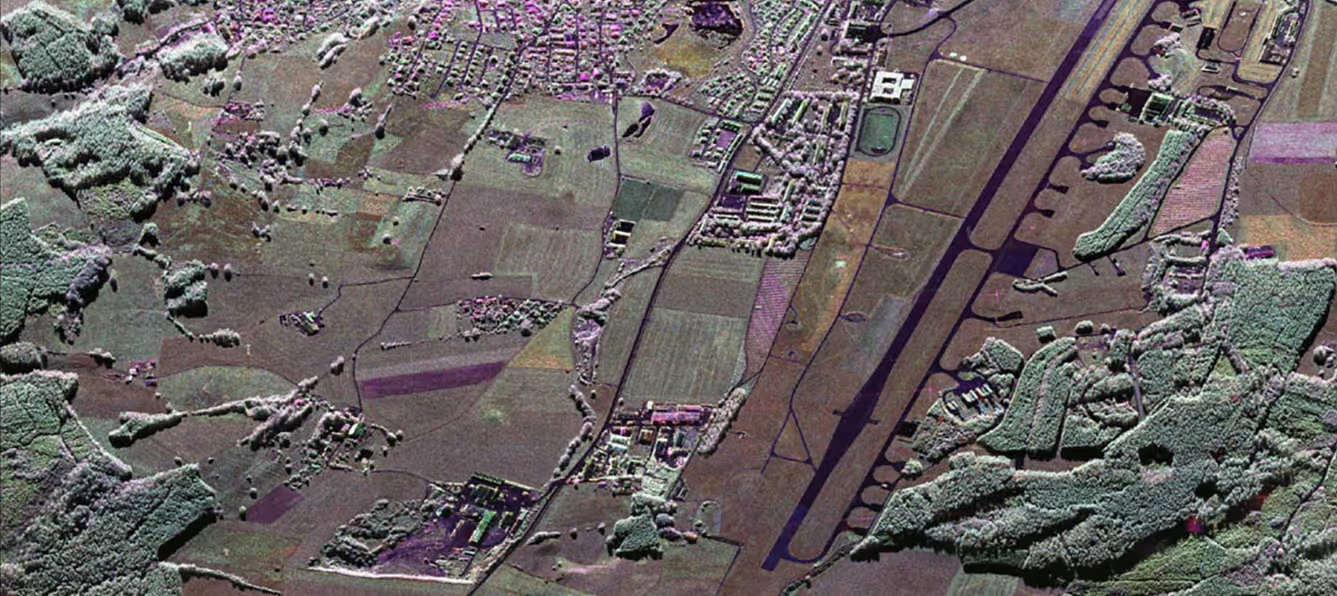
The moment a satellite collects a SAR image, it captures the state of the Earth's surface at a specific point in time, whether it be the location of a vehicle, the coordinates of a ship, the extent of flooding, or the arrangement of military assets. For customers requesting and tasking this data, accurate imagery is paramount. In this regard, Capella, an IonQ company, has long been an industry leader when it comes to consistently delivering high-quality, high-resolution SAR imagery.
But vehicles move, ships change course, floodwaters rise, and militaries change tactics. With every second that elapses from the time of collection to the time of delivery (latency), the difference between what’s represented in our SAR data and what’s actually on the ground increases. Simply put, the longer it takes our data to reach the people who need it, the less accurately it represents the current state of the world, regardless of quality.
In this sense, latency is as important a measure of data accuracy as resolution, geolocation accuracy, and radiometric fidelity. For many of our customers, timeliness matters just as much as image quality. For that reason, it also matters to us.
Understanding Latency
The most basic definition of latency, and the definition our customers care about, is simply “the time from when SAR data is collected (a “collect”) to when it is delivered and made available to the customer.”
But for those of us working to understand and lower our latency we need to take a more granular approach. At Capella, we break down and track our latency metrics into the following categories:
- Downlink Delay
- Downlink Duration
- Number of contacts for downlink
- Backhaul duration
- Payload Processing Pipeline duration
- SAR processing duration
- QA duration
Latency By The Numbers
Over the last 30 days* we have achieved:
- 97% of collects delivered in under 4 hours
- 93% delivered in under 3 hours
- 79% delivered in under 2 hours
- 1.35 average downlink contacts required
*Based on all collects, with an average collect size of 7.9 GB.
Getting to these results requires improving every stage of the path from orbit to delivery.
The following sections describe these individual latency drivers and the work we’ve done to overcome them, not as a single breakthrough, but as an ongoing campaign to decrease latency at every stage of the collection-to-delivery pipeline.
Downlink Delay
The time from when SAR data is collected by the satellite to when it is able to be downlinked at a ground station. In other words, after data collection, how long does it take the satellite to traverse to its next available ground station contact?
In theory, lowering Downlink Delay is straightforward -- just add more ground stations. The reality is a bit more complex. Ground stations must exist on land, have sufficient backhaul, little to no radio interference, and be licensed for use by our constellation. Plus, there are only so many ground stations that currently exist and that are made available to us.
What we can do is be strategic in the ground stations we use. By analyzing our current global coverage and understanding the tasking patterns of our customers we are always looking to onboard new antennas. We are currently in the process of adding multiple ground sites and will continue to review and expand our global footprint.
Downlink Duration
The time it takes to transfer a collect from space to ground.
The speeds at which our spacecraft transfer data to a ground station are primarily dictated by what MODCOD (Modulation and Coding) is used. MODCOD is a parameter set that defines how digital data is encoded and transmitted over a satellite link. Different MODCOD combinations offer different tradeoffs between data throughput and signal fidelity. Higher-order modulation schemes pack more bits per symbol, increasing throughput, but increase the potential for data loss.
At Capella, we’ve come to learn that faster isn’t always better when it comes to downlink. Through continued experimentation we’ve worked to find the sweet spot between downlink speed and data integrity. Our goal is to maximize the amount of intact data we get down in a single contact, giving us more consistent delivery times and lower average latency.
In the coming months we plan to run additional experimentation in this area and will be working closely with Kongsberg Satellite Services (KSAT) to further optimize our space-to-ground data transfers, both increasing capacity and decreasing latency while maintaining a low number of contacts for downlink.
Number of Contacts Required to Downlink
The number of ground contacts it takes to downlink the complete data set of a SAR collect.
One of the largest hurdles any satellite constellation faces is transferring data from space to ground. Data can get lost or corrupted in transit and contacts can be sparse, making antenna time one of our most precious commodities.
Capella satellites collect enormous amounts of data, especially for our highest resolution SAR products. Each satellite in the constellation will average around two Earth contacts per orbit. This means that for each additional contact required to downlink a complete data set 45 minutes or more is added to our latency.
Recent improvements in collection-to-delivery latency have come from working closely with our ground station providers to improve downlink quality. This has resulted in less data loss (holes) and fewer total contacts required for downlink. It has also resulted in much more consistent data delivery times with less variance.
In one example, we worked with KSAT, who provides KSATlite, a fully automated ground-station-as-a-service for small satellites, mega-constellations, and everything in between, to tune radio configurations to the demands of our high-rate downlinks, which sharply reduced data loss and the average number of contacts needed to bring down a complete data set.
We’ve also improved how our processing pipeline identifies and merges valid data between multiple contacts. Ideally, we would always downlink our data in a single contact, but data loss (holes) and partial downlinks are an inevitability with space-to-ground data transfers. When this does happen, our system is designed to re-downlink only the data it needs and to efficiently merge the valid data from each contact. If we can’t get the data down in one pass, we want to make sure it all comes down after two.
Backhaul Duration
The time it takes to backhaul downlinked data from a ground station to our secure private cloud.
Capella processes all of its customers’ data in a secure private cloud (AWS GovCloud) in the United States. With ground stations all over the world, some in extremely remote locations, there is a non-trivial amount of time it takes to backhaul the gigabytes of data for each SAR collect.
We continually evaluate the backhaul performance at every ground station and have worked closely with KSAT to identify and mitigate bottlenecks in these networks. In recent months KSATlite has more than doubled backhaul throughput at multiple locations. We have also worked with KSAT to identify future initiatives to further improve the backhaul throughput across our ground station network.
Payload Processing Pipeline Duration
The time it takes to parse, validate, decrypt, and assemble the downlinked, raw SAR data.
Data flow from our satellite constellation is inherently “bursty”. For one, our customers are often interested in specific areas of interest (AOI), confining the bulk of their tasking load to certain geographic regions. These regions can and do shift with world events. Secondly, our satellites are only in contact with the ground at sporadic intervals, during which as much data as possible is downlinked.
To account for this we recently overhauled our architecture to better handle the bursty nature of our network traffic. The new design allows for fully elastic, horizontal scaling throughout the payload processing pipeline. Once backhauled, whether we are processing 2GB or 200GB, our downlinked data is parsed, validated, decrypted, and assembled for SAR processing in 3-4 minutes.
SAR Processing and QA Duration
Where SAR processing starts, my expertise ends. But I do know that Capella has an incredible SAR processing team, doing amazing things with our data. They are always working to improve the algorithms we use and have automated the QA process.
The methodology behind how Capella does SAR processing would need its own blog entry to fully cover.
Our Partnership with KSAT
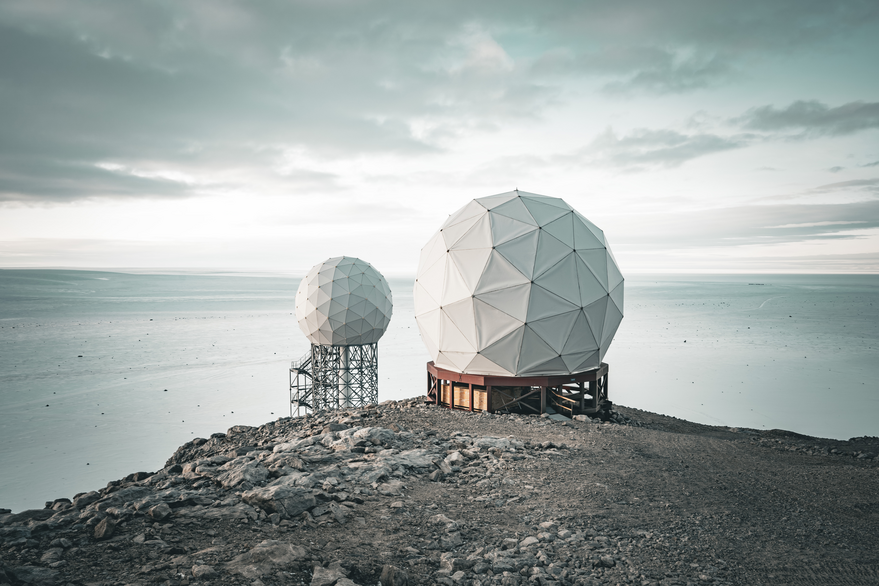
You may notice that a lot of the work we do to decrease latency involves working closely with our ground station providers. Their antennas, and the networks connecting them, are critical in how we get data from our spacecraft to our customers.
Ground station providers support numerous satellite operators with varying missions, data rates, and operational profiles. A ground station configured to support low volume data missions transmitting a few gigabytes per day may not be optimally configured for a SAR constellation transmitting hundreds of gigabytes, sometimes terabytes, per day as ours does.
We understand that we ask a lot of our ground station providers and are often pushing the limits of what their services typically handle. Because of this we maintain a close working relationship with our primary ground station provider, KSAT, who we have been in partnership with for over eight years. Together, we are continually working to identify and fix operational bottlenecks and to push the boundaries of what is possible.
“Capella asks a lot of the ground segment, and that's exactly what makes the partnership valuable. Working together across the downlink, antenna and backhaul, our teams keep finding measurable ways to improve delivery speed and consistency. Missions like this show us where the limits of the ground segment really are. Our job is to move those limits, and to make the result feel effortless for the operator.” - Arthur Kvalheim Merlin, Vice President of KSATlite
The Sensor Is Only the Beginning
Capturing a high-quality SAR image is an extraordinary engineering problem. But from the customer's perspective, the mission isn't complete when the satellite collects the data. It's complete when that information reaches the people who need it. The faster we can deliver our products, the more valuable they are to our customers. This is why we have been, and always will be, working to lower our constellation-wide latency.
We are proud of the latency numbers we’ve achieved and confident that we can do even better still. It’s often said that “space is hard”, which is true. It’s hard to put things into orbit, it’s hard to operate in inhospitable environments, and it’s hard to get large amounts of data back down to earth. We are doing all of those things, and we’re getting better at it every day.
Reducing latency requires thinking beyond the payload and treating the entire system, from spacecraft to antenna to terrestrial network to processing infrastructure, as part of the Earth observation architecture.
We will continue pushing every part of that system: using antenna time more efficiently, expanding the ground network, increasing throughput, improving processing, and working closely with our ground station partners. Because the objective isn't simply to produce a high-quality SAR image. It's to deliver the most accurate representation possible of what's happening on Earth and to do it while it still matters.
Connect with our team to learn more about our SAR data solutions
Image credit: KSAT
Curious Which Of Our Analytics Partners
Can Support Your Mission?
Contact our team to explore the possibilities. Our experts can help
you determine the optimal solutions for your unique needs.

Keywords
.avif)
Stay Informed. Stay Ready.
Get briefings on new capabilities, technology improvements, and upcoming events.


.avif)