September 24, 2026
Radar that builds its own antenna
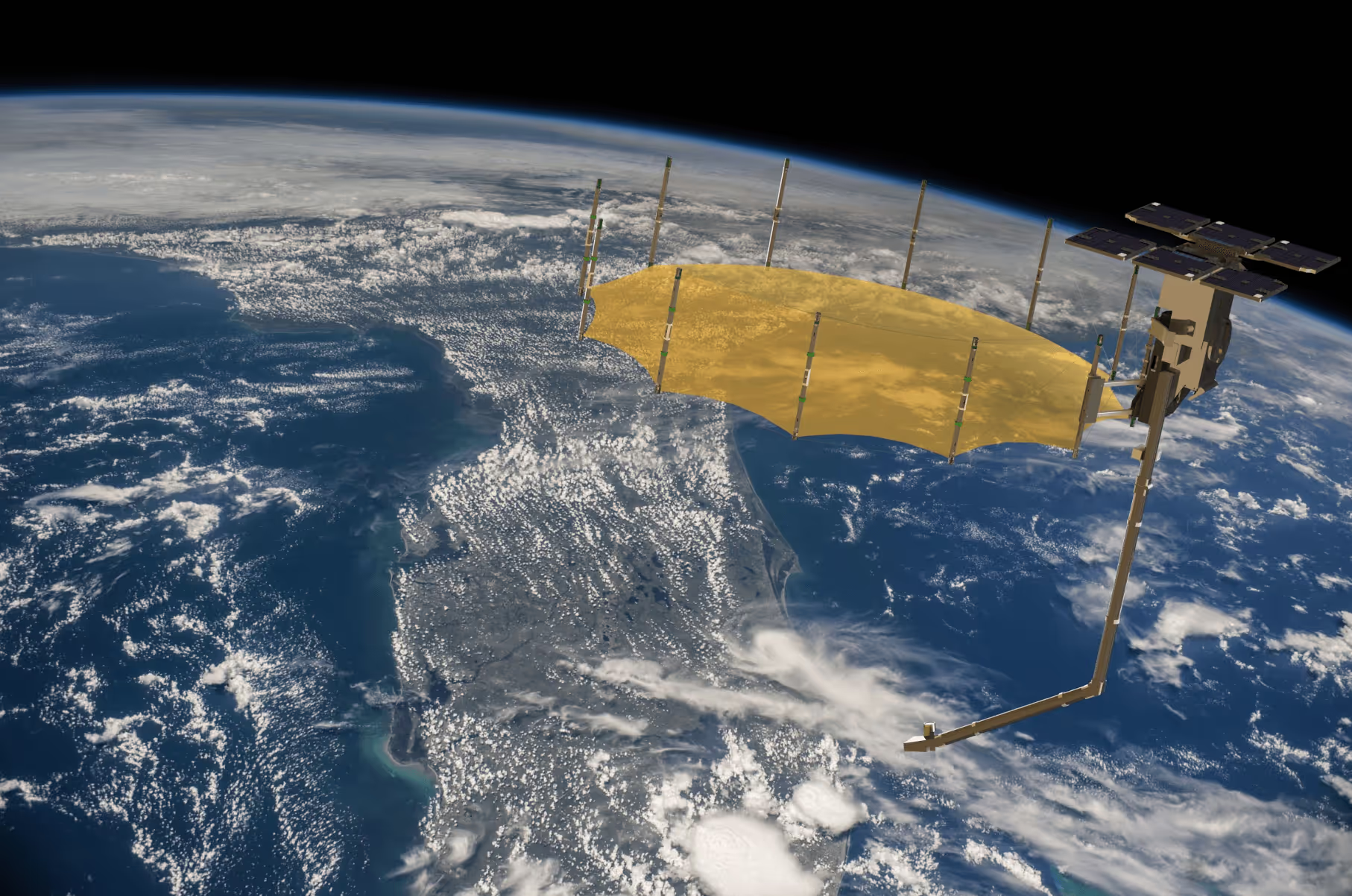
In June 1951, mathematician Carl Wiley at Goodyear Aircraft in Arizona noticed something while working on a guidance system for the Atlas missile program. When a radar is on a moving aircraft, returns from the front and back of the beam have slightly different Doppler shifts. A good intuition for this is a siren that sounds higher in pitch as it approaches you and lower as it moves away. Similarly, targets in the front of the beam behave like the approaching siren, and targets in the back like the receding one. Wiley realized that by combining the radar echoes coherently and sorting them by Doppler shift, a radar could form an image with much finer resolution than its real antenna allows, as though the motion of the aircraft had synthesized an antenna hundreds of meters long. Today, we call this technique synthetic aperture radar (SAR).
While SAR was initially used to image the Earth day or night and through clouds, a SAR image contains more than what’s visible to the eye: each pixel also contains phase information, which researchers used in 1993 to map the displacement from the Landers earthquake to roughly three centimeters accuracy by comparing the phase of two radar passes. Later work on coherent change detection showed that phase comparison can reveal disturbances at the scale of a wavelength, including tire tracks across dirt or a surface that has been walked on. Over the last decade, commercial constellations, including Capella's, have delivered sub-meter X-band imagery at a revisit cadence measured in days, which has greatly expanded the applications of spaceborne radar.
Change detection has been a natural SAR application since nearly the start, for an obvious reason: SAR pierces through clouds or darkness. It is the one modality uniquely suited to capturing a second look at the same scene when an application requires it. Applications ranging from disaster response, infrastructure monitoring, and land-use enforcement to defense and intelligence applications benefit from re-imaging a scene on demand. At its simplest, change detection asks: Given what this scene looked like before, what should it look like now if nothing happened? Anything that diverges from the prediction is flagged for a deeper look.
Why a radar engineer should be curious about quantum
There is a structural sympathy between the math underlying SAR and quantum mechanics. SAR is a coherent instrument. A SAR image is not simply a picture. Each pixel is a complex number carrying amplitude and phase information, and the image is formed through the interference of those returns. Speckle, the grainy texture characteristic of SAR imagery, is not simply sensor noise, but in-fact results from the interference of many sub-resolution scatterers. The mathematics of SAR processing therefore shares important concepts with quantum mechanics. Researchers including Soronzonbold Otgonbaatar at DLR, have explored this connection from the quantum side, including proposed implementations on a CubeSat.
Shared mathematics does not automatically create a quantum advantage, but it can provide natural ways to encode the problem as hardware advances. In just a few years, IonQ has grown from debuting 32 physical qubits in 2021, to 256 qubits in 2026, and is on track to realize 20,000 physical qubits by 2028. That makes now the time to run experiments on real data, ahead of the hardware advances on the horizon.
A lesson from the history of neural networks
Quantum machine learning today is roughly where neural networks were more than 20 years ago: theoretically interesting, practically difficult, and easy to dismiss.
Backpropagation was popularized in 1986. LeCun's convolutional networks were reading handwritten digits by 1989. Then came a long stretch where the ideas worked in theory, but were difficult to use in practice. Still, researchers kept advancing the field, and what ultimately changed the equation was not a new theory of learning, but computational plumbing. In 2012, AlexNet showed what a convolutional neural network could do when trained on GPUs. Our favorite artifact of that period is Alex Krizhevsky's 2014 paper, One weird trick for parallelizing convolutional neural networks. The title sounded like internet clickbait, but its contents were consequential. It proposed mapping the structure of a neural network onto the parallelism of multiple GPUs, significantly improving compute efficiency. That was the trick: not a discovery about intelligence, a new algorithm, or a mathematical breakthrough, but a careful mapping of an algorithm onto the machine running it. This kind of optimization helped unlock the deep-learning revolution of the 2010s, eventually, today’s era of large language models.
Quantum computing is still young, but the answer is not to wait for fault tolerance before looking for applications. Now is the time to identify real workflows where quantum approaches can be explored. As the hardware scales, we will better understand where to apply it.
What we measured
That is the goal of our recent paper, SAR and InSAR Change Detection with Quantum Generative Models, where we explored where quantum computing could complement the change-detection workflow.
Typically, a background estimator uses the conditional expectation, E[y|x], between images captured before and after the change of interest. With two real images, this can be estimated by creating a joint histogram of pixel intensities and calculating the mean within each bin. Things become more complicated with the type of SAR data that IonQ works with: sub-meter-resolution X-band imagery, where typical histogram-based estimates can fail. The conditional means are least reliable in the tails—exactly where accuracy matters for keeping false-alarm rates low. The standard remedy is to Gaussianize and spatially filter the data until the histogram becomes dense enough for existing change detection models.
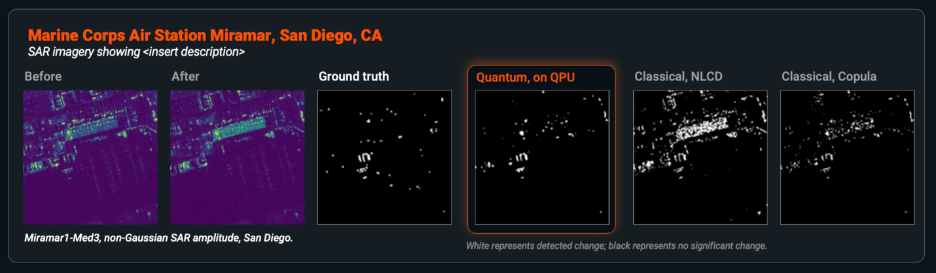
Rather than spatially filtering the data, we replaced the empirical conditional with a generative model: We used a quantum circuit Born machine (QCBM) over the copula of the joint distribution, using two registers of n qubits each. The circuit begins in a maximally entangled state, forcing each register's marginal distribution to remain uniform. Parameterized layers then learn the dependence structure by minimizing KL divergence against the discretized target.
The results, in short:
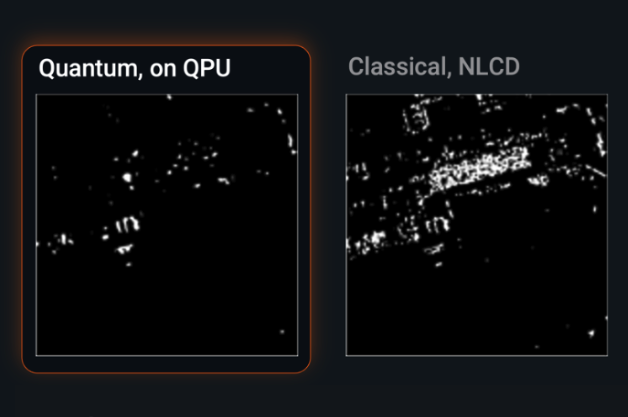
- For strongly non-Gaussian configurations, the QCBM reached filtered F1 of 0.41 against 0.16 and 0.24 for the two classical baselines. After a Yeo–Johnson transform made the marginals approximately Gaussian, that gap disappeared: 0.56 versus 0.55 and 0.56.
- When trained and run end-to-end on IonQ hardware at 20 qubits, the QCBM scored 0.32. Performance declined relative to the simulator but remained above both baselines.
- Performance improved with circuit size, from 0.09 at 4 qubits to 0.36 at 22, overtaking the lookup table at 12.
Future Direction
Researchers are already exploring a broad range of quantum computing applications for radar, including through DLR's QUA-SAR program. Three areas are particularly worth watching.
Focusing raw data. SAR image formation relies on matched filtering and a Fourier transform. The quantum range-Doppler algorithm maps reference functions directly onto quantum gates, reporting a core gate count of O(N) against the classical O(N log N).
Polarimetry. Polarimetry offers perhaps the clearest example of the encoding opportunity. The Poincaré sphere, used to describe polarization since the nineteenth century, is mathematically analogous to the Bloch sphere. In that sense, a Jones vector is already a qubit in different notation. That means polarimetric data can enter a quantum representation with no feature engineering or lossy dimensionality reduction—an unusual property among quantum machine-learning approaches in remote sensing. It is also higher-dimensional by construction, aligning directly with the sparsity challenge explored in our work.
Segmentation. SAR segmentation can also be posed as a Markov random field and approached using hybrid quantum annealing , particularly because the underlying problem is NP-hard.
Beyond these areas, sensor-design problems such as antenna geometry, waveform design, ambiguity suppression, and collection scheduling are also candidates for exploration with quantum methods. Further out is coherent processing at the orbital edge, where the instrument and computer might eventually stop being separate systems.
None of this demonstrates quantum advantage, and we are careful not to claim it does. What it does provide is a map—drawn today using real data from real satellites—of where quantum computing could take us next.
Sources and further reading
- SAR and InSAR Change Detection with Quantum Generative Models (arXiv:2609.05313)
- Continuous Variable Quantum Computing: CV-QC, S. Otgonbaatar, DLR Oberpfaffenhofen
- One weird trick for parallelizing convolutional neural networks, A. Krizhevsky, 2014
- The displacement field of the Landers earthquake mapped by radar interferometry, Massonnet et al., Nature 364, 1993
- Synthetic Aperture Radar, Engineering and Technology History Wiki
Note to Investors Regarding Forward-Looking Statements
This article contains forward-looking statements. All statements contained in this article other than statements of historical fact are forward-looking statements, including statements regarding IonQ’s projected timeline for producing 20,000 physical qubits. In some cases, you can identify these statements by forward-looking words such as “project,” “can,” “could,” “next,” “realize,” “on track,” “map,” “horizon,” “scale” and other similar expressions. These statements are only predictions based on our expectations and projections about future events as of the date of this article and are subject to a number of risks, uncertainties and assumptions that may prove incorrect, any of which could cause actual results to differ materially from those expressed or implied by such statements, including, among others, those described under the heading “Risk Factors” in our annual Report on Form 10-K for the year ended December 31, 2025 and our Quarterly Report on Form 10-Q for the quarter ended June 30, 2026 filed with the Securities and Exchange Commission. New risks emerge from time to time, and it is not possible for our management to predict all risks, nor can management assess the impact of all factors on our business or the extent to which any factor, or combination of factors, may cause actual results to differ materially from those contained in any forward-looking statement we make. Investors are cautioned not to place undue reliance on any such forward-looking statements, which speak only as of the date they are made. Except as otherwise required by law, we undertake no obligation to update any forward-looking statement, whether as a result of new information, future events or otherwise.
Curious Which Of Our Analytics Partners
Can Support Your Mission?
Contact our team to explore the possibilities. Our experts can help
you determine the optimal solutions for your unique needs.
Keywords
Stay Informed. Stay Ready.
Get briefings on new capabilities, technology improvements, and upcoming events.


.avif)